
Nikro Air Duct Cleaning in Provo: A Homeowner’s Guide
Most homeowners hiring a duct cleaner never find out what vacuum is about to run through their house. That’s the wrong order of operations. Nikro air duct cleaning in Provo is worth understanding because the machine attached to the hose decides what actually comes out of your ducts, how much of it stays contained, and whether the debris ends up in a sealed HEPA drum or back in your living room air. Below we explain what Nikro equipment does mechanically, how to tell contractor-grade gear from a glorified shop vac, and the exact questions to ask before anyone books you in.
If you’d rather skip the research and get a straight answer, call (877) 798-7857 and we’ll talk through what your system needs.
What does Nikro equipment actually do that a portable vacuum doesn’t?
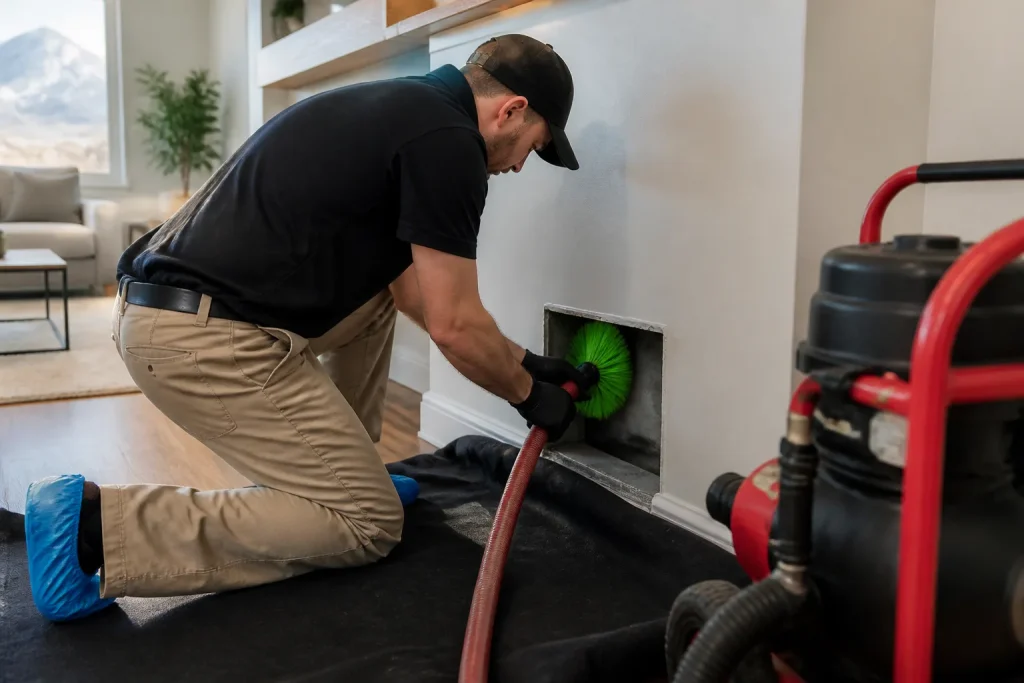
Nikro negative air machines create a pressure differential across your duct system. The machine pulls a measured volume of air (its CFM rating) through the ducts while a separate agitation tool loosens debris from the walls. The combination is what matters: negative pressure keeps contaminated air moving toward the machine instead of into your rooms, and mechanical contact breaks the settled layer of dust, dander and construction debris off the duct interior so it can be captured.
A shop-vac-class portable does neither well. It pulls low CFM, it doesn’t hold sustained negative pressure across a whole system, and it has no serious filtration stage. What happens in practice is the agitation knocks debris loose and the weak vacuum can’t carry it away before it settles back into the same runs or drifts into the return.
Key specs to understand:
- CFM (cubic feet per minute): the volume of air the machine moves. Higher CFM holds stronger negative pressure in more of the system at once, which is why a professional negative air setup can clean branch runs a portable simply can’t reach.
- HEPA filtration stages: professional machines pass exhaust air through graded filters, with HEPA as the final stage, so what leaves the machine is filtered rather than just blown out. A portable with a cloth bag is not in the same category.
- Containment: the point of negative air is that contamination travels one way. Without containment, cleaning a contaminated system can spread debris into the home.
The picture here is what matters. Your Provo house sits in a valley that traps inversion layers and fine dust through the cold months, so duct systems here collect a genuinely mixed load of outdoor particulate and indoor dander. Strong negative pressure and real filtration are what make that load leave the house instead of redepositing.
Truck-mounted negative pressure versus portable machines: what gets left behind?
Truck-mounted negative pressure systems generate far stronger suction than any portable unit because the power source isn’t limited by a household circuit. The practical result is that a truck-mounted setup can pull debris out of long branch runs, the return plenum and the trunk line without the technician having to reach every inch by hand. Portables are limited to the length of hose they can serve and the suction they can sustain at the end of it.
What gets left behind with a portable is usually the far ends of branch runs and the settled material in low spots. It’s the layer that doesn’t move unless the airflow is strong enough to lift it and the pressure is maintained long enough to carry it out. Homeowners describe this as “they cleaned it but the smell came back” or “the dust in the supply registers didn’t change.” Those are the fingerprints of an underpowered job.
Nikro negative air equipment is built for the pattern you see when a system is genuinely cleared: the supply registers run clean air, the return pulls without that musty edge, and your HVAC blower doesn’t kick up a sneeze cloud on first start. That’s the outcome to expect from a real clean. It’s not always what homeowners get.
How do I verify what equipment a company is actually using before I book?
Ask direct questions and listen for direct answers. A contractor running Nikro or Abatement Technologies gear will name the brand and the machine without hesitation. A company running a portable with a marketing brochure will tell you “we use professional equipment” and change the subject. The signal is in the specificity of the answer.
Questions to ask before booking:
- What brand and model of vacuum will be on site? You’re listening for a brand name (Nikro, Abatement Technologies) and a model. “Professional-grade” alone is an evasion.
- Is it negative air or positive pressure? Negative air is the standard. Positive pressure without containment can push debris into living space.
- Does the machine have HEPA filtration? Allergies or a recently renovated home make this non-negotiable.
- How will you agitate the duct walls? The right answer involves a mechanical contact tool, not just airflow.
- Can I see before-and-after photos of my own ducts? Not stock photos. Your ducts.
If any answer is vague, that’s your answer. A crew proud of its equipment will tell you what’s running. If you want a reference point, the air duct cleaning page walks through what a properly equipped clean looks like for a Provo home.
Why is Nikro the standard in remediation and what does that mean for my Provo house?
Remediation contractors work under strict protocols for contaminated environments: mold, sewage, wildfire smoke, post-construction dust. They can’t use equipment that redistributes particles. That’s why the equipment they rely on (Nikro negative air machines, Abatement Technologies containment units) is built to a different spec than consumer or budget-cleaner gear. When a duct cleaning company runs that class of equipment, the technical capability is the same whether the job is a routine clean or a post-renovation system with drywall dust packed into the returns.
Provo homes face several contamination-level scenarios more than homeowners realize:
- Recent renovations: drywall dust, sawdust and insulation fibers settle into return ducts and stay there for years if not extracted.
- Newer builds: construction debris is often left inside the duct system itself and becomes airborne the moment the system runs under load.
- Efficiency-sealed homes: a tightly wrapped house in the valley traps indoor pollutants the way it traps heat. Ducts become the concentration point.
- Post-mold or post-water damage: once remediated, ducts need a system-level clean with containment, not a surface pass.
Homes fitted with integrated air quality systems (Honeywell and Aprilaire components in particular) need a technician who understands how those work with the duct infrastructure. A standalone clean without regard for the IAQ hardware can leave the whole-home system performing worse than before.
What does a Nikro-equipped clean actually look like from start to finish?
In a typical Provo single-family home, a full-system clean runs two to four hours depending on the number of registers and how much debris is in the returns. Here’s what you should observe:
- Setup and containment: the technician caps or seals registers not currently being cleaned and positions the negative air machine at the main trunk or return, establishing airflow toward the machine.
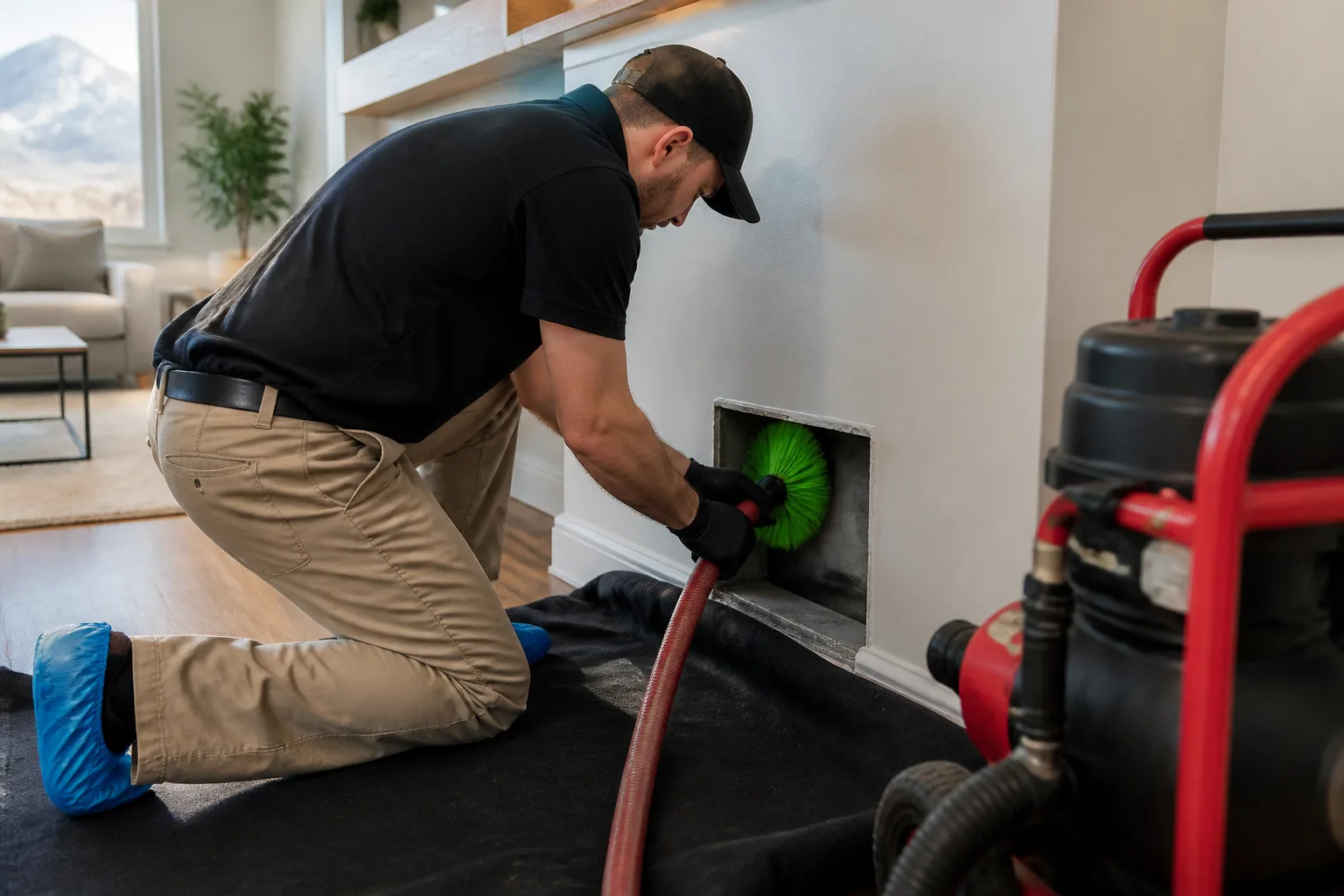
- Contact agitation: a mechanical tool runs through each branch and the trunk to break settled debris off the duct walls.
- Simultaneous extraction: the negative air machine pulls loosened debris out through HEPA filtration, holding contamination in the system until it’s captured.
- Inspection and photography: before-and-after photos of your ducts document what changed. You should see them yourself, not just a verbal summary.
- System check: registers reinstalled, airflow confirmed, IAQ components checked if present.
During the clean, you should hear steady machine noise, not the intermittent roar of a portable cycling to keep up. You shouldn’t see dust drifting out of other registers or settling on surfaces. If you do, the containment failed.
When to call a pro: if anyone in the house has allergies or asthma that flare after the HVAC kicks on, if you’ve recently renovated or bought the home, if the return registers show visible buildup, or if a “cleaned” system still smells musty, those are signs a real clean is overdue. Our technicians have up to 13 years of experience with systems like these.
Related services in Provo: if the clean reveals torn flex duct, disconnected joints or crushed runs (common causes of the air-loss symptoms homeowners mistake for a dirty system), Air Duct Repair fixes the structural problem rather than masking it. And if the dryer is taking longer than usual or the vent smells warm, dryer vent cleaning is a fire-safety issue worth scheduling before more cleaning.
The Bottom Line
Nikro air duct cleaning in Provo is about equipment, process and verification, not marketing. A negative air machine with real CFM and HEPA filtration, paired with mechanical contact agitation, extracts the debris a portable cannot. When you’re comparing quotes, ask the specific questions above; a company running Nikro or Abatement Technologies gear will answer them without flinching. Nothing here is a substitute for a proper Provo assessment, but it’s a fair filter for who gets the booking.
If you’re in Provo and need help, Duct Cleaning Provo offers free estimates for air duct cleaning, dryer vent cleaning and air duct repair. Call (877) 798-7857. We answer 24/7. Fast dispatch from 7am to 7pm, Sunday through Friday.
Frequently Asked Questions
You’ll see wildly different numbers because some companies quote per vent and others quote per system. Per-vent pricing is the bait-and-switch pattern to avoid; the invoice tends to grow once the technician is on site. Ask for one flat price for the whole system, agreed before work starts, and confirm what that price covers. A written estimate for your specific system is the only honest number. Call (877) 798-7857 for a free estimate.
Usually because they’re running portable vacuums with weak suction rather than Nikro negative air machines, or because the per-vent quote only covers the visible registers, not the trunk and returns. Cheaper quotes are often quoted per vent and grow once the technician is on site; more expensive quotes reflect the real equipment and time a full-system clean takes. Ask what machine will be on site before you decide. Call (877) 798-7857 for a free estimate.
Before-and-after photos of your own ducts, taken by the technician and shown to you. That’s the proof. Ask to see the machine on arrival, and confirm it’s the brand and model the company said it would use. If those two things check out, the work is verifiable. If not, ask why. Call (877) 798-7857 for a free estimate.
Most Provo homes benefit from a full-system clean every three to five years, and sooner if the home recently changed hands, went through a renovation, or houses someone with allergies or asthma. New construction can need a first clean within the first year. If any household member reacts to the HVAC turning on, that’s sooner rather than later. Call (877) 798-7857 for a free estimate.
Written by the team at Duct Cleaning Provo.
Need Air Duct Cleaning Help?
Call Duct Cleaning Provo - licensed & insured, with free written estimates in Provo.
(877) 798-7857